



BLOOD TRACKING SERIES 09
An optical filter does more than make a flashlight beam look different. It changes which parts of the light spectrum reach the scene—and that can change how surfaces appear relative to one another.
Quick Answer
An optical filter selectively transmits some parts of the light spectrum while reducing or rejecting others.
In a blood tracking light, that can change the relative brightness and color of leaves, soil, bark and other surfaces. The goal is to create useful visual contrast, making subtle differences easier to notice under suitable conditions.
The filter does not chemically detect blood, and no filter can guarantee the same result on every surface.

What Is an Optical Filter?
Some filters transmit a relatively narrow portion of the spectrum. Others allow a broader range through while reducing selected wavelengths. Optical filters may achieve this through absorbing materials, optical coatings or other engineered structures.
The important idea is simple:
the filter changes the light before that light reaches the environment.
Optics manufacturers use filters across imaging, machine vision, microscopy and other applications because controlling transmitted wavelengths can significantly change image contrast.

How Can Filtering Change Visual Contrast?
Different surfaces reflect and absorb light differently.
If a filter changes the spectrum reaching those surfaces, their relative appearance can change as well. One material may become visually brighter while another appears darker or less dominant.
That separation is contrast.
This same basic principle is used in imaging applications, where color filters can make objects easier to distinguish by changing the intensity relationship between different colors.
For tracking, the important point is not that a filter “finds” something automatically.
It gives the eye a different version of the same scene.

Is an Optical Filter Just a Colored Lens?
Not necessarily.
A filter should be understood by what wavelengths it transmits or reduces, not simply by what color the lens appears to the human eye.
Two filters that look similar can have different spectral transmission characteristics.
Likewise, a colored LED and an optical filter are not exactly the same thing. A colored LED shapes the light at the source, while a filter changes the light that is allowed to pass through the optical system. A flashlight design may use one approach or combine multiple optical elements.
That is why beam color alone does not tell you everything about the underlying optical design.
Why Can an Optical Filter Need So Many Coating Layers?
Some optical filters use multilayer thin-film coatings rather than relying only on coloured glass.
During manufacturing, very thin layers of optical materials with different refractive indices can be deposited onto a glass or optical substrate under controlled conditions.
Each layer is designed with a specific thickness. Together, the layers create interference effects that influence which portions of the light spectrum are transmitted, reduced or reflected.
Depending on the optical design, a filter may contain dozens—or in some precision applications, more than one hundred—individual thin-film layers.
More layers do not automatically mean a better filter. Performance also depends on the materials, layer thickness accuracy, optical design, angle of incidence and manufacturing consistency.
Do All Optical Filters Work the Same Way?
No.
Optical filters broadly include technologies such as absorptive or color-substrate filters and coated or dichroic filters. Different designs transmit, absorb or reflect different parts of the spectrum in different ways.
For a hunting flashlight, however, the engineering label matters less to the user than the final result:
Does the optical system create useful contrast in the field without making the light impractical to use?
That result depends on more than the filter itself.

Why Does the Surface Still Matter?
Even a carefully designed optical filter cannot control the terrain.
Leaves, soil, bark, moisture and vegetation all interact differently with illumination.
Forensic-light research demonstrates the same limitation: background substrate and biological material can significantly affect what is visible under alternate illumination, and false positive or false negative observations can occur.
That is why there is no responsible claim that one filter will produce identical tracking visibility on every surface.
For the broader principle, see BT-02 — How Does a Blood Tracking Light Work?
What Can an Optical Filter Not Do?
An optical filter cannot chemically confirm that a mark is blood.
It cannot guarantee that every trail will become obvious.
And it cannot overcome every difficult combination of distance, moisture, background color and ambient light.
A filter is part of an optical observation system.
Its job is to shape light and support contrast—not to replace careful observation or turn a flashlight into laboratory detection equipment.
FIELDLUME B1 Blood Tracking Light
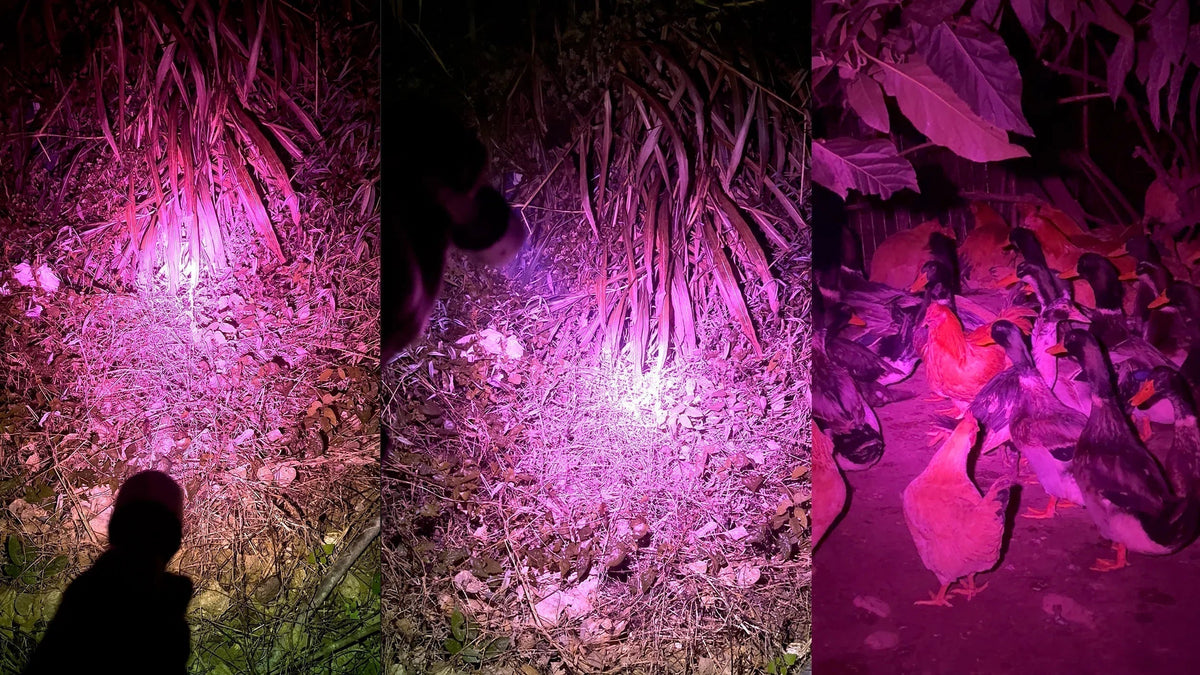
The FIELDLUME B1 Blood Tracking Light uses a custom optical-filtering approach as part of its low-light tracking system.
FIELDLUME does not need to claim that one wavelength or one filter works best everywhere. The more useful goal is to provide another way to examine terrain when ordinary illumination does not create enough useful visual separation.

Share: