


Flashlight Lumens Explained: Does More Mean Better?
Lumens are usually one of the first specifications people notice when comparing flashlights.
A higher lumen number means more total visible light output—but it does not automatically mean a flashlight will shine farther.
Understanding that difference makes flashlight specifications much easier to compare.
High Output Is Only Part of the Story
The FIELDLUME TAC20 Tactical Flashlight combines high output with a focused long-range beam, showing why both brightness and beam design matter.

What Are Lumens?
A lumen (lm) is a unit used to measure luminous flux—the total amount of visible light produced by a source.
In simple terms:
More lumens = more total light.
That can be useful when you want to illuminate a wide area, such as a campsite, backyard, work area, or trail.
But lumens do not tell you where that light goes.
Why Don't More Lumens Always Mean More Distance?
Imagine two flashlights producing a similar amount of light.
One spreads that light across a wide area.
The other concentrates it into a tighter beam.

The second flashlight may reach much farther even if its lumen output is similar—or sometimes lower.
That is because beam distance also depends heavily on candela, optics, reflector or lens design, and beam shape.
Candela measures luminous intensity in a particular direction rather than total output.
Related Guide: Candela Explained →
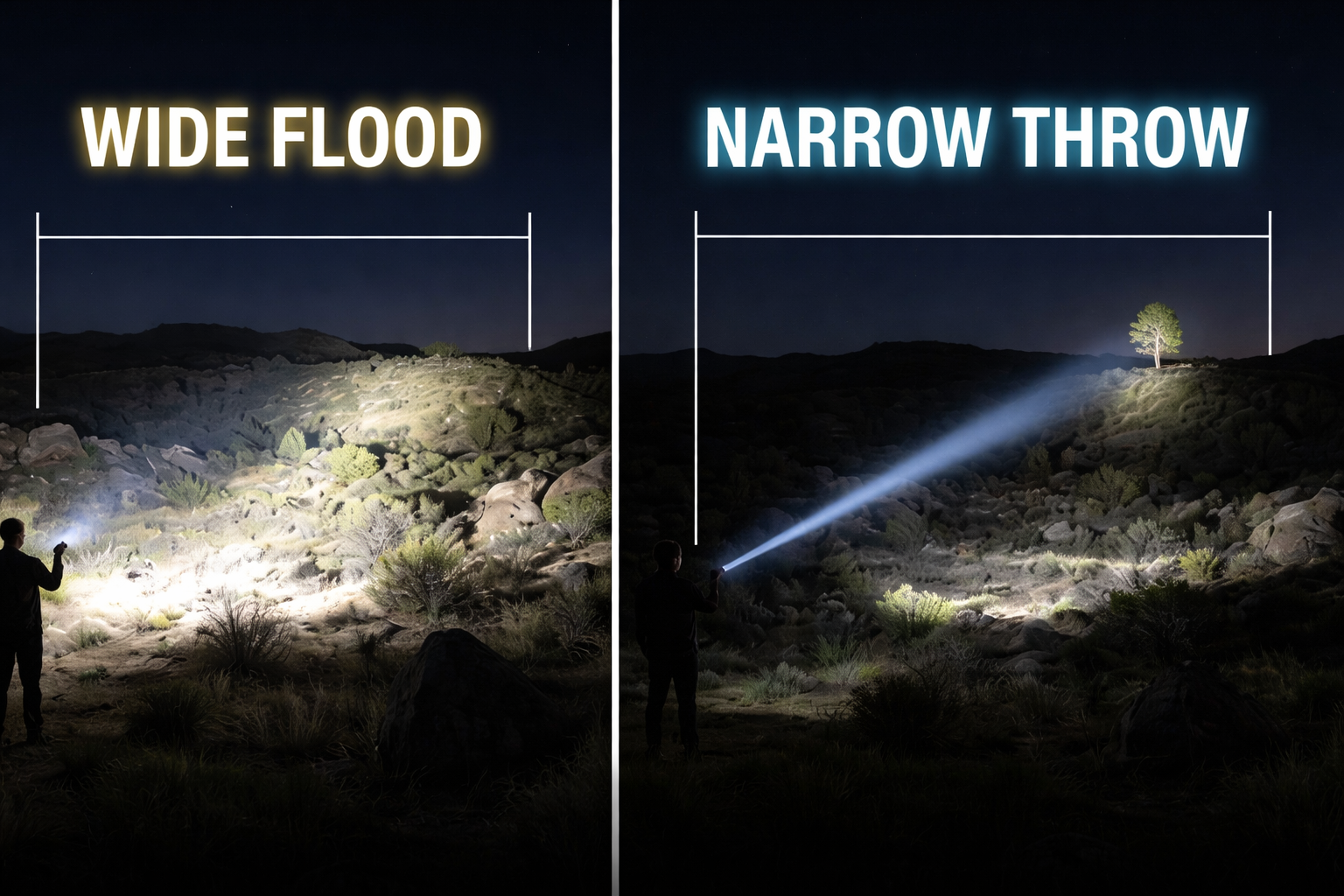
Flood vs Throw
A flood beam spreads light widely.
It is useful for:
- close-range visibility;
- walking;
- work areas;
- general illumination.
A throw beam concentrates more light toward the center.
It is useful when longer-distance visibility matters.
Neither beam style is automatically better. They are designed for different tasks.
A Real-World Example: FIELDLUME TAC20
The current FIELDLUME TAC20 is specified at 2350 lumens with a beam distance of up to 685 meters.
Notice that these are listed as two separate specifications.
That is useful because:
Lumens describe total output.
Beam distance describes how far the complete optical system can project usable light.
One number cannot replace the other.
What Should You Check Besides Lumens?
When comparing flashlights, also look at:
Candela — beam intensity.
Beam distance — stated reach of the beam.
Beam pattern — flood, balanced, or focused throw.
Optics — reflector and lens design.
Runtime — how long useful output can be maintained.
The highest lumen number is only one part of the flashlight.

Key Takeaway
Lumens tell you how much visible light a flashlight produces.
They do not tell you exactly how far the beam will reach.
For a more complete comparison, look at:
Lumens + Candela + Optics + Beam Pattern + Runtime
See Output and Beam Design Working Together
The FIELDLUME TAC20 Tactical Flashlight combines high output with a focused beam designed for longer-range outdoor illumination.

FAQ
Do more lumens mean a brighter flashlight?
More lumens mean greater total visible light output, but perceived brightness also depends on how the beam is distributed.
Do more lumens mean longer beam distance?
No. Beam distance also depends strongly on candela and optical design.
Are lumens or candela more important?
It depends on the task. Lumens are useful for total output, while candela is especially relevant when beam intensity and distance matter.
Share:
How to Choose a Flashlight for Emergencies
Candela Explained: What Does It Mean for a Flashlight?