


SMO vs OP Reflector: What’s the Difference in a Flashlight Beam?
Two flashlights can use similar LEDs and produce similar lumen output, yet create noticeably different beams.
One reason is the reflector.
Some flashlight reflectors have a smooth mirror-like surface. Others use a lightly textured finish often called orange peel, or OP.
Both designs can work well. They simply shape the beam differently.

Beam Shape Matters
The FIELDLUME TAC30 Tactical Flashlight uses a focused optical system for long-range visibility, making it a useful example of why beam design matters beyond lumen output. The current TAC30 is rated up to 2400 lumens with up to 590 meters of beam distance.

What Is a Smooth Reflector?
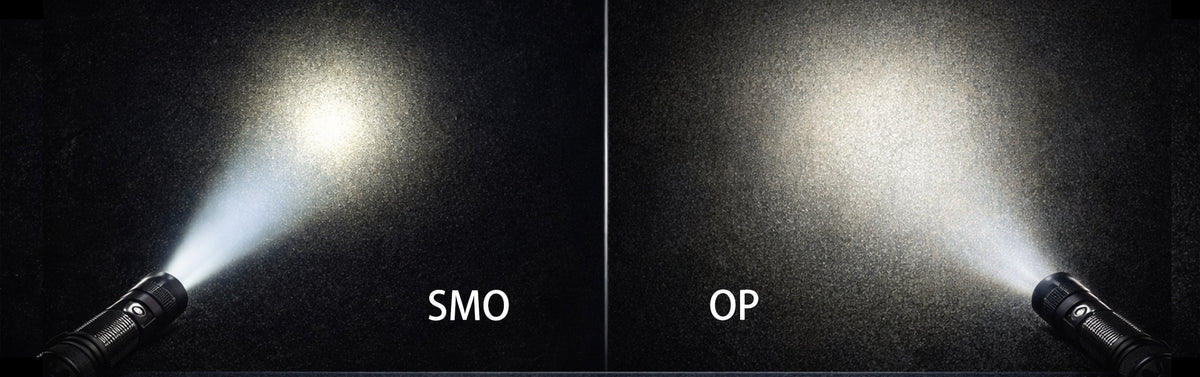
A SMO reflector has a polished, mirror-like surface.
Its job is to redirect light from the LED forward with relatively little diffusion.
This can produce:
- a more defined central hotspot;
- stronger separation between hotspot and spill;
- higher directional intensity when paired with suitable geometry.
SMO reflectors are often used when a more concentrated beam is desired.
What Is an OP Reflector?
An orange-peel reflector has a fine textured surface.
That texture slightly diffuses reflected light and can help blend the hotspot into the surrounding spill.
An OP reflector can produce:
- a softer hotspot edge;
- smoother beam transitions;
- a more blended-looking beam.
This can be useful where even illumination matters more than having the sharpest possible hotspot.
Does SMO Always Throw Farther?
Not automatically.
Reflector texture is only one part of beam design.
Beam intensity and distance also depend on:
- reflector diameter and depth;
- LED size and position;
- lens design;
- LED output;
- overall optical alignment.
A well-designed OP reflector can still produce useful distance, while a small SMO reflector may not be a long-range system.
So it is better to think of reflector type as one factor in the complete optical design.
SMO vs OP: Quick Comparison
| SMO Reflector | OP Reflector | |
|---|---|---|
| Surface | Smooth | Lightly textured |
| Hotspot | More defined | More blended |
| Beam transition | Sharper | Softer |
| Typical preference | Focused beam | Smooth general beam |
Neither one is universally better.
The right choice depends on the beam you want.
How Does This Relate to Lumens and Candela?
Reflector design does not create extra lumens.
Instead, it helps determine where the available light goes.
That is why two flashlights with similar lumen output can have different candela and beam-distance figures.
Related Guide: Lumens vs Candela →
A Real-World Example: FIELDLUME TAC30
The TAC30 combines high output with a focused long-range beam.
Its 2400-lumen maximum output and 590-meter specified beam distance are separate specifications because total light output and beam projection are not the same thing.
That is the practical lesson behind reflector and optical design:
The beam depends on how the flashlight shapes the light, not only on how many lumens the LED produces.
Key Takeaway
SMO and OP reflectors shape light differently.
SMO tends to create a more defined hotspot.
OP tends to create a smoother, more blended beam.
But reflector texture alone does not determine flashlight quality or beam distance.
The complete optical system matters.
See Focused Beam Design in Real Use
The FIELDLUME TAC30 Tactical Flashlight combines high output with a focused beam designed for long-range outdoor visibility.

FAQ
Is a smooth reflector always better for long range?
No. Reflector size, depth, LED position and the rest of the optical system also affect beam intensity and distance.
Is an OP reflector less powerful?
Not necessarily. It changes how the beam is distributed rather than simply making the flashlight weaker.
Which reflector is better for EDC?
There is no universal answer. Many users prefer smoother beam transitions for close-range use, but the best choice depends on the complete flashlight design.
Share:
Lumens vs Candela: Which Matters More in a Flashlight?
Flashlight Color Temperature Guide: Cool White vs Neutral vs Warm White