



BLOOD TRACKING SERIES 04
What tracking lights can realistically help with, what they cannot guarantee, and why field conditions matter.
Quick Answer
Yes, blood tracking lights can help improve visual contrast in some low-light tracking situations.
But they do not automatically reveal every trail, and they should not be treated as chemical detectors. Their effectiveness depends on the optical design of the light, the surface being examined, moisture, ambient light, beam angle and the condition of the trail itself.
The most accurate way to think about a tracking light is simple: it is a visual aid that may make certain clues easier to notice under suitable conditions.
What Can a Blood Tracking Light Actually Do?
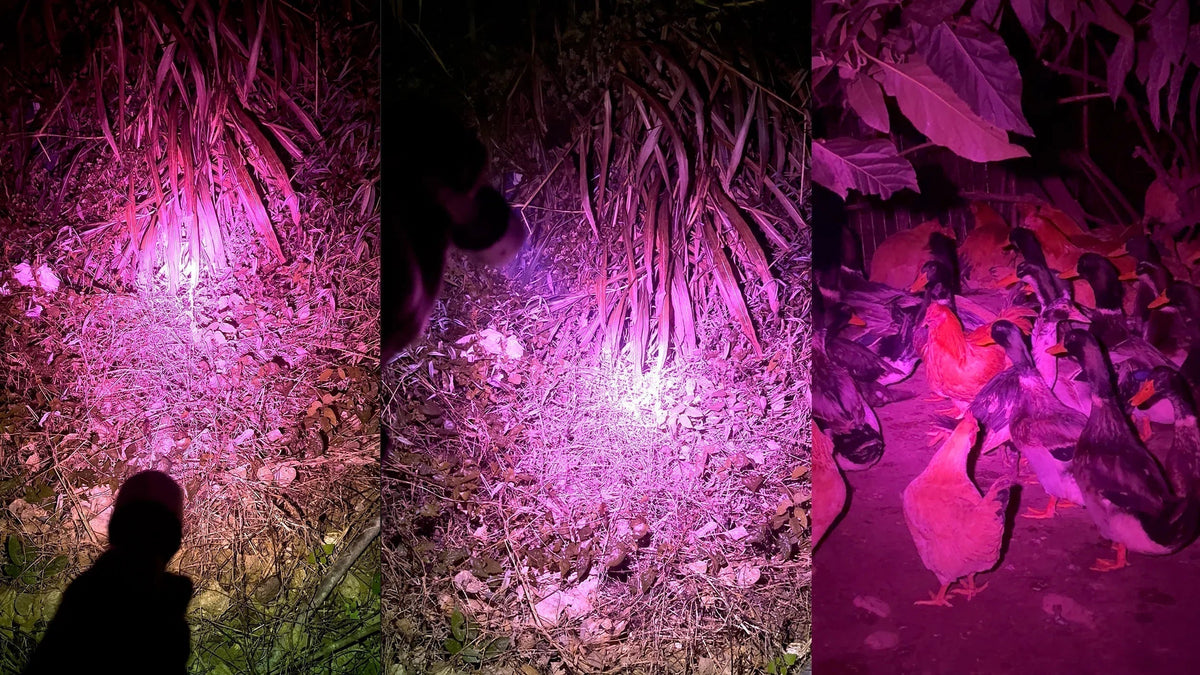
A purpose-built tracking light changes the way parts of a scene appear to the eye.
Selected light or optical filtering can alter the relative brightness and color contrast between leaves, soil, bark, vegetation and a possible trail indicator.
That extra separation can make a subtle clue easier to notice.
This does not mean the light is identifying a substance. It is changing the way the scene is illuminated so the user has another visual way to examine it.
For the optical principles behind this, see BT-02 — How Does a Blood Tracking Light Work?
Why Do Results Vary So Much?
Outdoor environments are extremely inconsistent.
A surface that creates useful contrast when dry may look different when wet. Green vegetation behaves differently from brown leaf litter. Pale rocks may reflect more light than dark soil. Ambient moonlight, distance and beam angle can also change what the user sees.
Forensic research with alternate light sources demonstrates the same broad limitation: the substrate underneath biological material can have a major effect on visibility, and no single wavelength or method performs perfectly in every situation.
That is why real-world results can vary.

What Can’t a Tracking Light Guarantee?
A blood tracking light cannot guarantee that a trail will be visible.
It also cannot confirm that a mark is blood simply because it appears different under a particular light.
Alternate-light techniques used in forensic work are generally treated as preliminary visual tools rather than standalone confirmation methods. The same cautious principle is useful in the field.
A tracking light can support observation.
It cannot replace careful tracking, experience or judgment.
Is White Light Sometimes Better?
Yes.
A good white flashlight can be extremely useful for navigation, broad searching and examining natural colors.
In some environments, high-quality white light may be all the user needs.
In other situations, strong reflections from wet leaves, pale surfaces or vegetation can reduce useful contrast. A tracking light provides another visual option when normal illumination is not giving enough separation.
The goal is not to prove that one type of light is always superior.
It is to give the user more than one way to examine the same environment.
For a detailed comparison, see BT-05 — Blood Tracking Light vs Regular Flashlight.

So, Do Blood Tracking Lights Really Work?
The best answer is:
They can help—but conditions matter.
A well-designed tracking light may improve useful visual contrast and make some trail indicators easier to distinguish. Its value is highest when the optical system, terrain and lighting conditions work together.
That is very different from saying every trail will become obvious.
For hunters, realistic expectations are more useful than dramatic claims.

FIELDLUME B1 Blood Tracking Light
The FIELDLUME B1 Blood Tracking Light 1800LM combines high output with optical filter technology to provide another visual tool for low-light tracking.
It is designed to support careful observation across real outdoor surfaces such as vegetation, soil and leaf litter.
VIEW THE B1 BLOOD TRACKING LIGHT


Share: